Modbus Tcp Server
Overview of Modbus TCP
Modbus is a serial, Client/Server protocol. Modbus TCP is the implementation of Modbus on Ethernet. For detailed information, visit https://www.modbus.org/
Clients request data using Function Codes FC, and Server will reply accordingly.
A Modbus TCP Server is identified by IP Address and Port Number. Conventionally, Port Number 502 is popular, but other Port Numbers may be used as well.
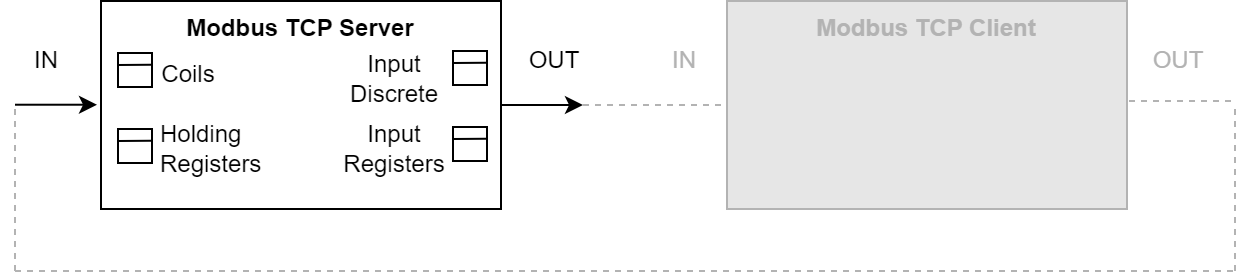
Server / Client structure of Modbus TCP
A Modbus TCP Server keeps data in 4 tables.
|
Table Name |
Client Access |
Row Storing Data |
Read FC |
Write Single FC |
Write Multiple FC |
Data Address |
|
Coils |
RW |
Bit |
01 |
05 |
15 |
0000...FFFF |
|
Input Discrete |
R |
Bit |
02 |
N/A |
N/A |
0000...FFFF |
|
Input Registers |
R |
Word |
04 |
N/A |
N/A |
0000...FFFF |
|
Holding Registers |
RW |
Word |
03 |
06 |
16 |
0000...FFFF |
Deskval Workbench is a Modbus TCP Server
Deskval Workbench exposes its Modbus tables data, called as Modbus TCP Server Tags and is symbolized with  .
.
In 16 bit register table, a NUM value is occupies 2 registers. Deskval Modbus Tcp Server stores as Big Endian, that means High Word first then Low Word.
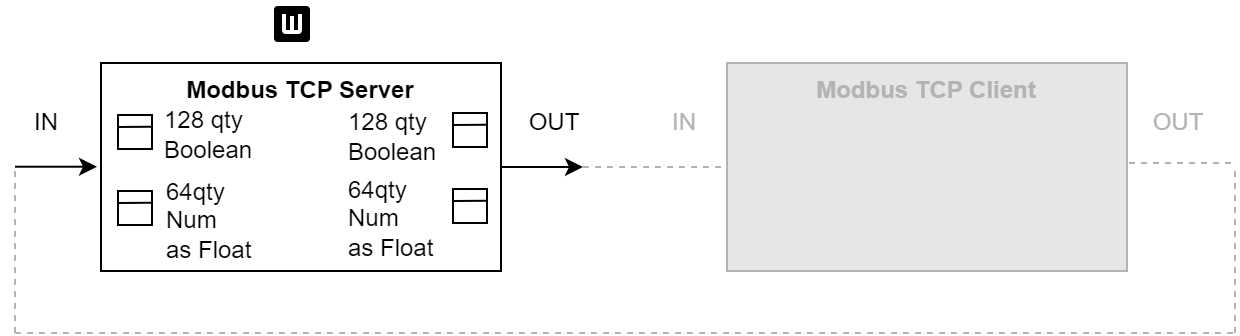
Deskval Workbench is a Modbus TCP Server
Modbus TCP Server Tags
|
Deskval Workbench Modbus Server Tags |
Description |
||||||
|
|
|
||||||
|
Output |
|

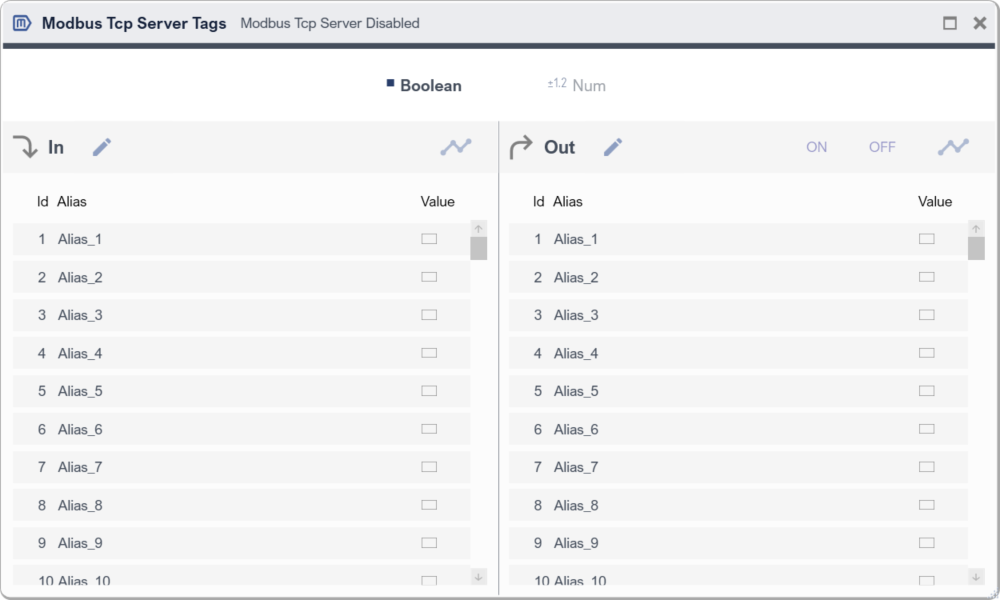
Modbus TCP Server Tags
Deskval Workbench - Plc Modbus TCP Communication Example
PLC sample programs that communicate with Deskval Workbench via Modbus TCP is provided for your convenience:
|
Plc |
IDE |
Remark |
|
Beckhoff |
Twincat 3 |
Please visit https://github.com/Deskval |